
Everyone knows Porvoo, the famously photogenic wooden town near Helsinki. But here’s a well-kept secret: there’s another one just down the coast. Loviisa is smaller, quieter, and, dare we say, even more charming — and miraculously free of selfie sticks.
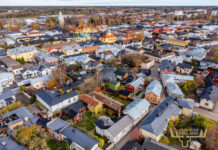
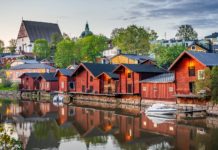
What you’ll find instead: wide streets lined with colorful 19th-century wooden houses, cobbled corners that look straight out of a period film, and a calm, time-traveling atmosphere that makes you want to speak in whispers.
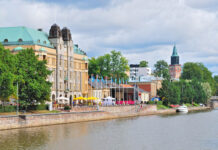
Even the “modern” town center — a relative term in Loviisa — still channels a bygone era.
Oh, and without Loviisa, Finland’s most famous composer might never have become Jean Sibelius. He would’ve stayed plain old Janne. History was changed here, one business card at a time.
And if you find yourself falling for Loviisa, you’re in noble company: when Swedish King Adolf Frederik visited in 1752, he liked it so much he renamed the town after his wife, Queen Lovisa Ulrika. It’s not every day a town gets a royal rebrand.
Start at the Church – and Meet Young Jean
Begin your visit near the striking central church. Right next door is the Sibelius House (Sibeliuksenkatu 10), a modest wooden home where Janne Sibelius — not yet the brooding national composer — spent sunny childhood summers with his grandmother.
Years later, Janne came back, rummaged through a drawer, and found some old business cards belonging to his late uncle, a sea captain who had fancied himself Jean Sibelius. The name had a certain ring to it. Janne borrowed it — and the rest is Finnish musical history.
He returned again in 1892, aged 27, and composed his Kullervo symphony right there in the house.
Today the building hosts a music school, so you can’t peek inside — but you can admire it from the outside and visit the nearby Sibelius Park. There’s even a statue, although it oddly depicts Sibelius as a dignified old man rather than the wild-haired young genius he was in Loviisa.
Just a few blocks away is Seurahuone (Kuningattarenkatu 24), a handsome civic building where Sibelius once gave a concert. It later served as the town library and is now being lovingly restored for events and celebrations.
Looking to stay somewhere with a touch of 19th-century flair? Try the atmospheric 1800’s Townhouse, just a short stroll away. Or check in to Uninen Loviisa — “Sleepy Loviisa” — a place that sounds like it should come with its own lullaby.
Bonga Castle – Where Color Runs Wild
Near the church, things take a vibrant turn at Bongan linna (Bonga Castle), a delightfully theatrical villa that doubles as the home and gallery of artist Riitta Nelimarkka. Step inside, and you’ll be swept into a kaleidoscope of bold, joyful colors — the kind that make even the sun blink.
The villa itself is a feast for architecture lovers: originally Art Nouveau, it was later redesigned in a neoclassical style by Hilding Ekelund, the same guy who gave Helsinki its Taidehalli and Töölö Church.
Bonga Castle is open in summer — check ahead for opening hours. Bonus trivia: Nelimarkka is the mother of crime writer Max Seeck. Art clearly runs in the family, though in very different shades.
From here, it’s an easy walk to Loviisa’s real treasure: its old wooden neighborhoods.
The Wooden Heart of Loviisa
Loviisa’s charm peaks in its wooden house districts, especially along Kuningattarenkatu and Mariankatu. These streets haven’t changed much in over a hundred years — and that’s exactly the point. Sibelius played here as a boy; you’ll probably just wander around saying “aww” a lot.
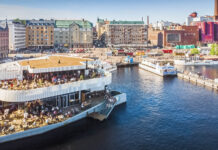
The main streets lead to Suolatori (“Salt Square”), a nod to Loviisa’s past as a salty little port. From there, follow Puutarhakatu down to the beach, or stroll Laivasilta Street to the guest harbor.
There you’ll find a maritime museum and seaside restaurants inside beautiful old red warehouses. Anchored at the pier is Österstjernan, a hand-built replica of the sailship that once hauled cargo between Loviisa and Stockholm. Talk about dedication.
Kids will be happy at Onneli and Anneli’s Playground, next to a retired tugboat and a modern labyrinth inspired by ancient Finnish stone mazes. It’s whimsical, weird, and wonderfully Loviisa.
A Café of a Thousand Pains (And One Great Apple Tree)
No visit is complete without a stop at Tuhannen Tuskan Kahvila — “The Café of a Thousand Pains.” Despite the dramatic name, it’s pure pleasure. The name actually refers to the back-breaking renovation work the owners did turning an old horse stable into a cozy café.
Today, it’s a tranquil spot with timber walls, homemade cakes, and an apple tree growing in the middle of the courtyard like something out of a fairytale. You may never want to leave.
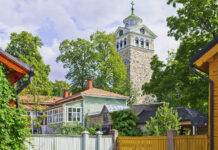
Kukkukivi – The Prettiest Lookout Tower You’ve Never Heard Of
Set on a ridge called Myllyharju, just outside town, the Kukkukivi lookout tower is a cast-iron beauty built in 1906 in rare Jugend style. From the top, sweeping views of Loviisa Bay unfold like a gentle sigh.
It’s a short, lovely hike — and there’s even a photogenic old windmill nearby if you’re the postcard type (and who isn’t?).
The Beach and Willa Björksten
At the foot of the ridge is Loviisa’s beach — yes, there’s a beach — and nearby is perhaps the dreamiest accommodation in town: Willa Björksten, where you can stay in the stately main house or one of the garden bungalows tucked under the trees. You may start planning your novel here.
Svartholma – Sea Fortress with a Story
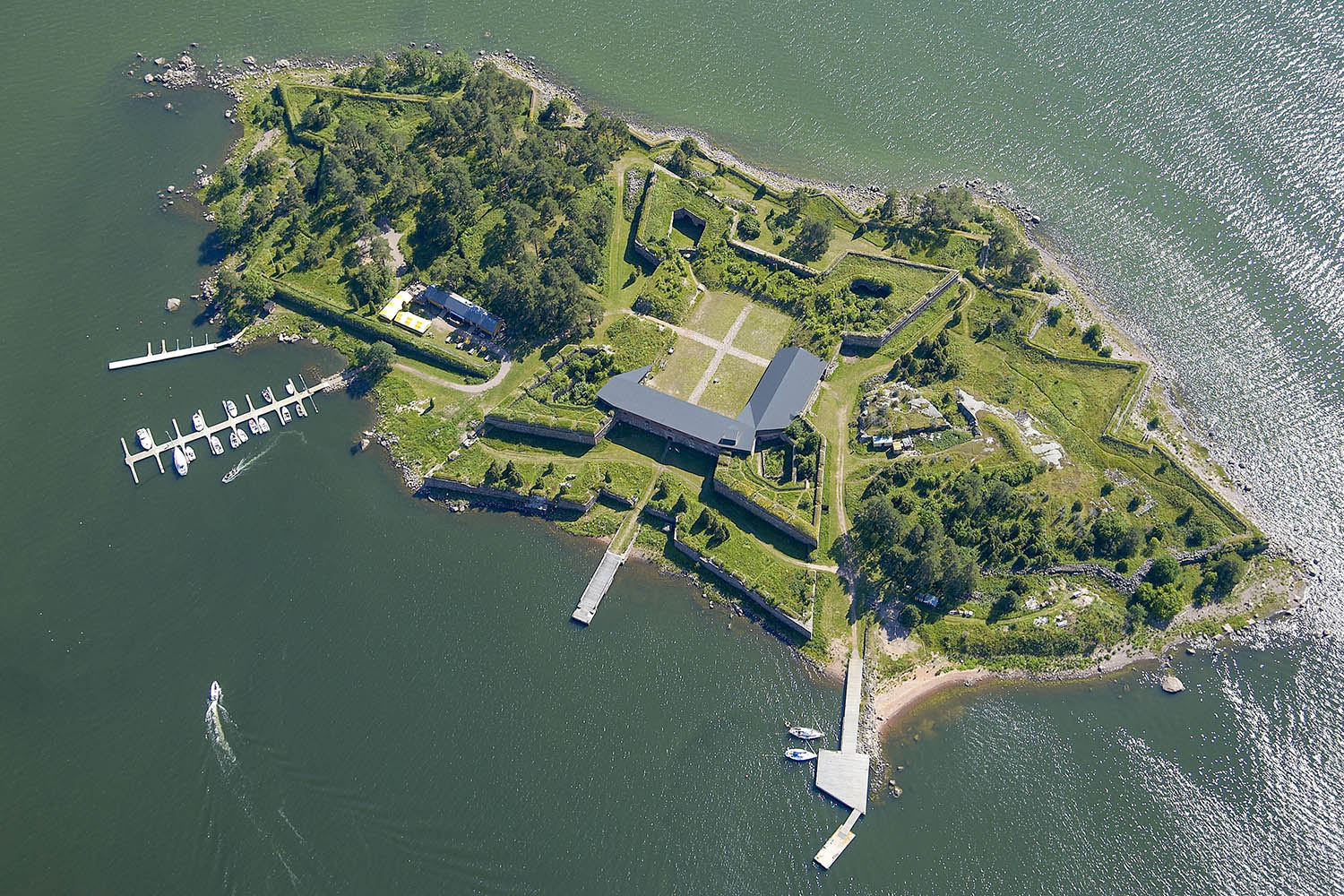
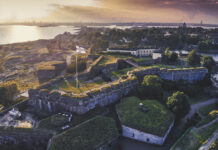
At the mouth of the bay stands Svartholma, a star-shaped sea fortress built in the mid-1700s alongside Suomenlinna. The difference? Suomenlinna gets the glory. Svartholma gets the peace and quiet.
During the Finnish War in 1808, the fortress was surrounded by Russian troops. After a month, the garrison surrendered — without firing a shot. But they did march out proudly across the ice, swords intact and band playing. You’ve got to respect the flair.
Later used as a prison and blown up during the Crimean War, the fortress has since been restored — and remains one of Finland’s most underrated historical sites.
In summer, boats depart from Loviisa’s harbor (a 40-minute journey). Space is limited to 30 people per boat, so book ahead if you don’t want to be left waving from the dock.
Take the guided tour — it brings the old stones vividly back to life.
Strömfors Ironworks – A Dash of History and a Hint of Schjerfbeck
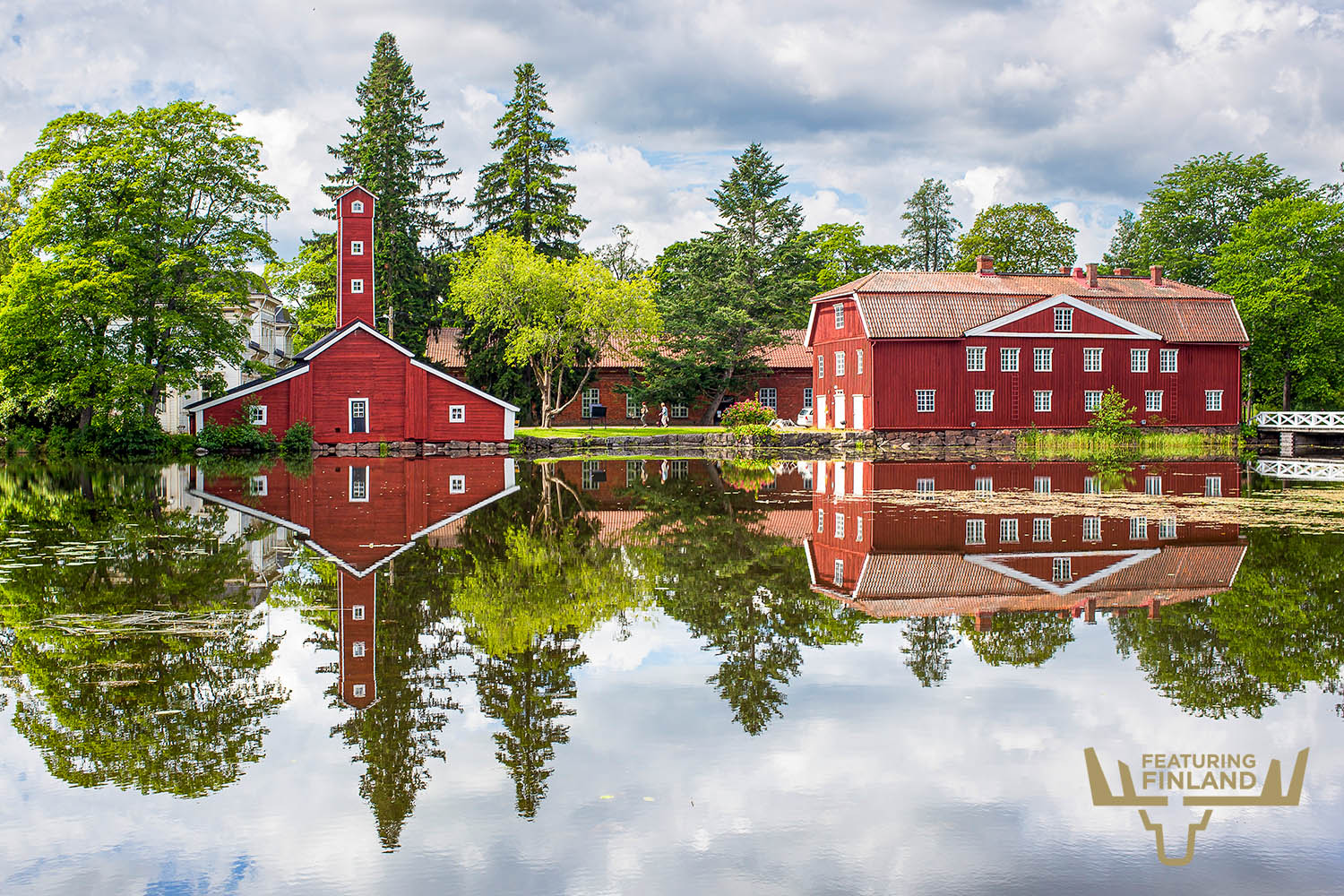
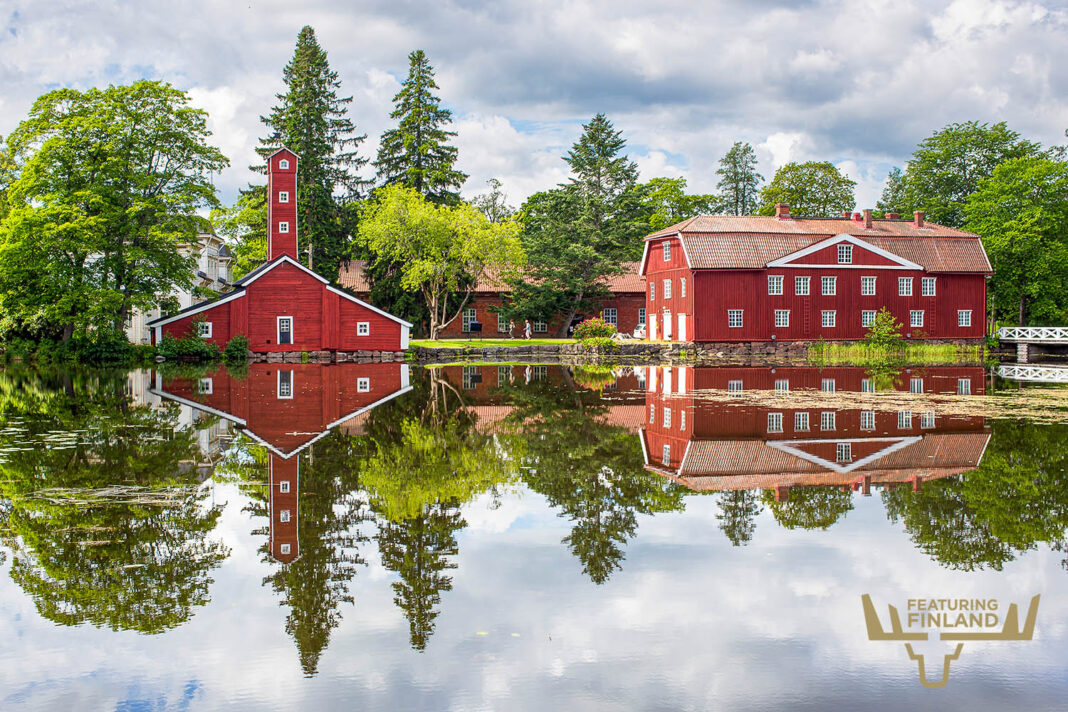
About 15 km from Loviisa, the village of Ruotsinpyhtää (or Strömfors, depending on your mood) offers one of Finland’s most charming ironworks villages. There’s a bubbling brook, handsome factory buildings, artisan shops, a working smithy, and — naturally — cafés.
The real surprise? The church. Its small white wooden interior holds an altarpiece painted by none other than Helene Schjerfbeck. Not her greatest work, perhaps, but certainly her most unexpected.
Loviisa at Christmas – A Fairytale Come to Life
Loviisa shines in summer — but it glows in December. On the second and third weekends of the month, residents decorate their historic wooden homes for Old-Time Christmas, and invite visitors in.
It’s warm, twinkly, and faintly magical. Throw in mulled wine, snow-dusted streets, and charming markets, and suddenly you’re in a Nordic Christmas card.
Getting There
Loviisa is just a one-hour drive from the capital, making it perfect for a day trip from Helsinki — though you might wish you’d stayed longer. It also pairs beautifully with Kotka, just 35 minutes further along the coast.
Did you like this article? If you’re planning a trip to Finland, please book your hotel or rent a cabin or rental car by clicking on our affiliate links. We get a small commission, but you don’t pay any extra. Thanks for your support!