

When exploring a new country, visiting its art museum offers a unique glimpse into its soul. Every nation boasts its own master artists—perhaps unfamiliar names, yet their works resonate as profoundly as those of Van Gogh or Monet. An art museum isn’t merely a collection of beautiful paintings; it’s a fast track into the heart of a nation, to its history, culture, and identity.
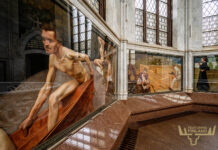
In Helsinki, that place is Ateneum, Finland’s grand old art temple and spiritual home of Finnish painting. Opened in 1888, it’s part of the Finnish National Gallery, and serves as a comprehensive introduction to Finnish art.
There’s not much international art here (except in top-tier temporary exhibitions), but there is one notable exception: a genuine Van Gogh. In a delightful footnote to art history, Ateneum was one of the first museums in the world to acquire a Van Gogh. The painting, Street in Auvers-sur-Oise, was bought not because of prophetic vision, but because it was on sale. A very Finnish way to make history.
So who should you see at Ateneum? Here are the stars of the permanent collection—and the paintings that best tell Finland’s story:
Albert Edelfelt – Finland’s First Art Celebrity
A cosmopolitan talent who made his name in Paris, but never stopped painting the Finnish light. Edelfelt’s glowing portraits (Queen Blanca) and breezy landscapes (Boys Playing on the Shore) combine French finesse with Nordic melancholy. He was the first to prove that Finnish art could hold its own internationally.
💡 Fan tip: If you fall for Edelfelt’s golden brushwork, take a day trip to his charming hometown of Porvoo to visit his seaside studio.
Helene Schjerfbeck – The Modernist Before Modernism
Quiet in life, radical in paint. Schjerfbeck’s famous self-portraits—especially the haunting Self-Portrait, Black Background—show the artist peeling back layers of identity with every stroke. Reserved, raw, and absolutely modern, her works have become Finland’s most internationally valued.
Her self-portraits form a kind of visual autobiography that becomes more haunting with each canvas. In the early works, the gaze is cautious, almost guarded. But as the years go by, the brushwork loosens, the features dissolve, and the portraits grow starker—until by the end, you’re looking not just at a face, but at the idea of a person on the edge of disappearance. It’s not vanity or ego on display, but mortality, honesty, and a radical stripping-away of all artifice.
Elsewhere in the museum, Schjerfbeck’s earlier realist works—like The Convalescent or The Baker’s Daughter—show her technical brilliance and storytelling ability. But even these hint at the emotional restraint and clarity that would define her later, more modern style.
What makes her so poignant is how her paintings manage to be both deeply personal and completely universal. In her silences, in the way she pares back everything nonessential, she speaks to something in us that words rarely reach. She didn’t just paint faces; she painted time itself eroding the mask of self.
💡 Pilgrimage alert: She spent her final decades in the seaside town of Ekenäs—well worth a visit if her work speaks to you.
Akseli Gallen-Kallela – The National Mythmaker
Gallen-Kallela turned Kalevala, Finland’s national epic, into a visual saga. His works crackle with drama, symbolism, and turbulent skies. His work fuses folklore, national pride, and art nouveau elegance—think Tolkien with a paintbrush.
While The Defence of the Sampo isn’t in Ateneum (you’ll have to go all the way to Turku for that), Ateneum does hold some of his most important pieces—like Lemminkäinen’s Mother, where grief, myth, and maternal strength all gather in one unforgettable image.
This poignant painting portrays a scene from the Kalevala where the hero Lemminkäinen has been slain and his body cast into the river Tuonela (Finnish version of Hades). His mother, embodying unwavering maternal devotion, retrieves and reassembles his remains, awaiting a divine bee to deliver honey from the gods to revive him. The composition, reminiscent of a pietà, captures themes of grief, hope, and resilience, reflecting the depth of Finnish mythology and national identity.
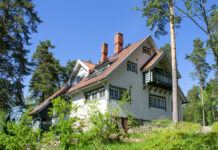
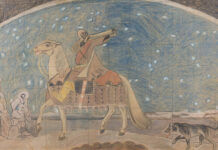
💡 Fan tip: Just in the outskirts of Helsinki, you can delve deeper into his world at the Gallen-Kallela Museum in Tarvaspää. And don’t miss the National Museum of Finland, where Gallen-Kallela’s dramatic Kalevala-themed frescoes adorn the entrance hall. Or if you become a truly devoted fan like we are, check our article on Gallen-Kallela.
Hugo Simberg – Painter of the Beautifully Uncanny
Hugo Simberg didn’t just paint scenes; he painted fables—delicate, eerie, and utterly his own. His world is stitched together with quiet oddities: angels who limp, skeletons who garden, devils who seem more awkward than evil. At the Ateneum, stepping into Simberg’s work feels like slipping into a dream where the strange is gentle and the symbolic is deeply human.
His most famous painting, The Wounded Angel, is one of Finland’s most beloved—and most mysterious—images. Two boys solemnly carry a blindfolded, bandaged angel through a grey spring landscape. The mood is somber, the meaning elusive. Is it a funeral? A rescue? A burden? The painting offers no explanations, only a lingering, aching question. And that’s exactly why it endures.
Simberg’s magic lies in how he treats the supernatural not as spectacle, but as something domestic, even tender. Death in his paintings is not a figure of fear, but a quiet presence trimming roses. His devils are not tormentors, but tragic, oddly endearing creatures.
There’s a softness in Simberg’s symbolism—a sense that behind every strange image is a fragile truth about life, loss, or growing up. His work doesn’t shout. It whispers, and somehow that whisper stays with you.
Eero Järnefelt – Poet of Finnish Labor and Landscape
His iconic Under the Yoke (Burning the Brushwood) is a national treasure: a smoky, almost cinematic portrayal of farm workers clearing fields by fire. You can practically smell the ash and feel the silence.
Järnefelt is also beloved for his paintings of Koli, the dramatic hill range that has become Finland’s national landscape (kansallismaisema). In Finland, this term refers to iconic views that symbolize the spirit of the country—typically involving a lake, a forest, and at least one brooding cloud. Koli delivers all three.
Practical Info
Ateneum Art Museum is located right in the city center, across from the Central Railway Station—about as convenient as it gets.
Opening hours and ticket prices vary slightly by season and exhibition, so it’s best to check the official website before your visit. Tickets are free for anyone under 18, and discounted for students and seniors.
There’s also a lovely museum café and a great little shop, perfect for picking up art books or beautifully designed souvenirs. Allow at least 1–2 hours to explore—longer if you fall under the spell of Finnish melancholy.
Did you like this article? If you’re planning a trip to Finland, please book your hotel or rent a cabin or rental car by clicking on our affiliate links. We get a small commission, but you don’t pay any extra. Thanks for your support!